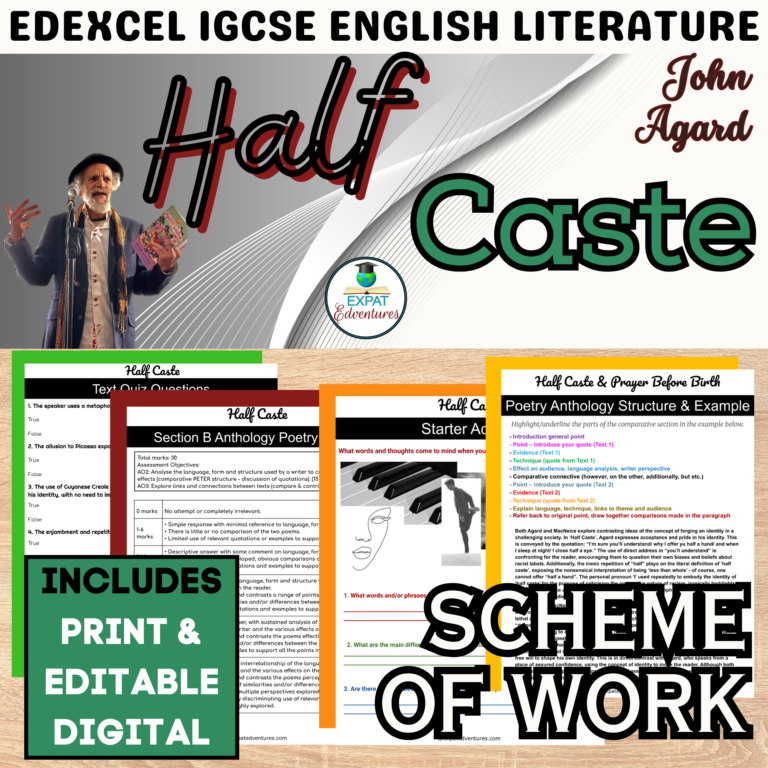
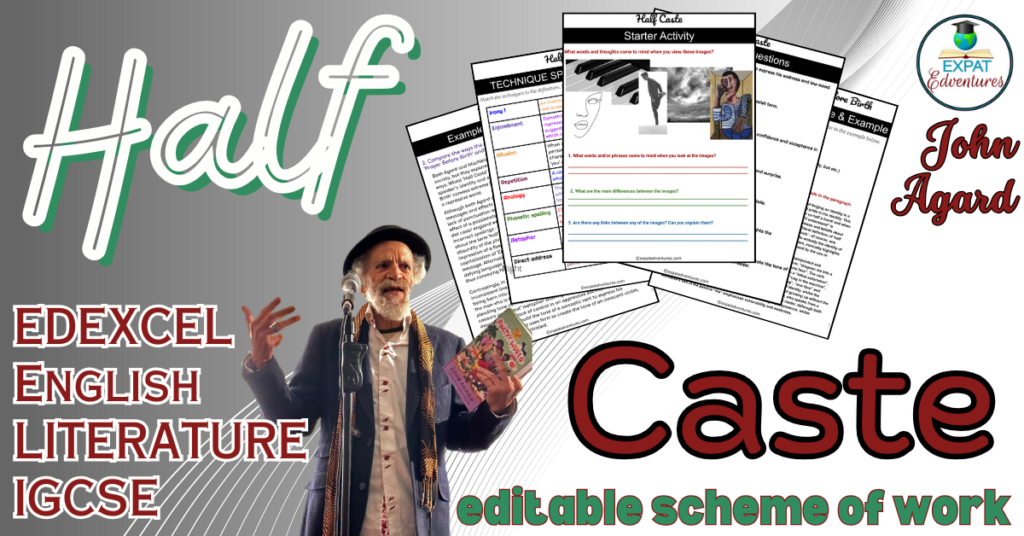
The poem ‘Half Caste’ by John Agard is currently taught on the Edexcel International GCSE English Literature Paper 1 curriculum. It is one of the 16 poetry anthology texts which students answer on for Section B. This complete ‘Half Caste‘ IGCSE resources pack comes packaged in a cohesive poetry unit. It includes line-by-line annotations, quiz questions with an answer key, a comparison grid, rubric and exemplar full mark answer.
Half Caste John Agard Context
‘Half Caste’ by John Agard is used as a vehicle to express the poet’s frustration and anger at the derogatory term ‘half caste’. In particular, Agard unpicks the meaning of the phrase, by ironically embodying the identity of ‘half caste’. Also, he humorously mocks the reader, invoking them to question their own biases. Born in Guyana and moving to the UK when he was an adult, Agard was likely exposed to cultural tensions and racism.
Agard uses metaphors to convey his message about the dangers of unchecked derogatory labels, but how can we support students to capture that in their exam essays? How can we break it down to consider not only the literal depiction of a frustrated rant, but the wider message about the negative effects of stereotyping, racism and oppression?
The 2 hour 15 minutes Edexcel IGCSE English Literature Paper 2 exam is split into Section A, Section B and Section C. It is worth 60% of a student’s English Literature grade. It is split up as follows:
Section A is a 20-mark unseen poetry question: students demonstrate their ability to analyse and understand unknown, new texts by answering one question on a poem.
Section B is a 30-mark thematic comparison of two poems from the 16-poem anthology: students will demonstrate their ability to compare two poems from the anthology and have two questions to choose from.
Section C is a 40-mark question based on a studied novel: students will demonstrate their ability to understand and explore themes and characters in a novel as well as the context the novel is set in and have two questions to choose from.
Accordingly, Paper 1 is a closed book exam, so students do not have access to the studied novel. However, they are given clean copies of the poetry anthology to respond to Section B.
Half Caste Poetry Analysis and Resources
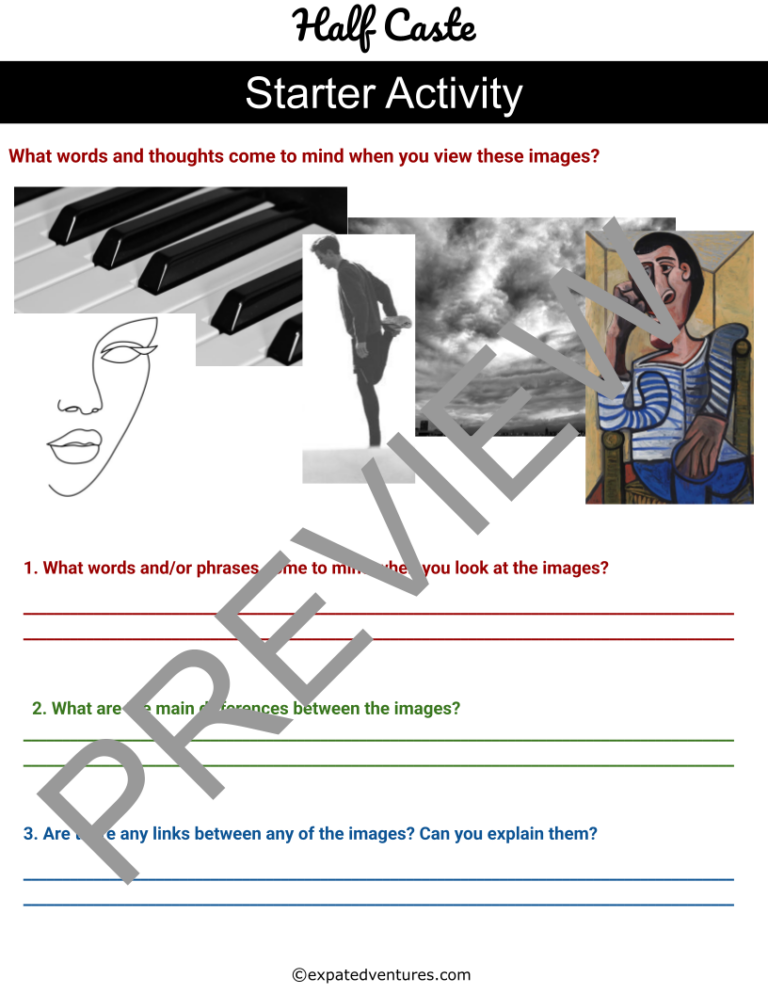
To introduce the poem ‘Half Caste’, I show a variety of images related to the poem. I ask for words, links and ideas that come to students’ minds. Then, they discuss for 5 minutes or so in pairs or small groups before we do class feedback. As the poem has such vivid imagery, this is an important way into the poem. We discuss things such as contrasting images of art, music, and the weather. Helpfully, it allows them to explore ideas of creativity and colour. The Half Caste IGCSE resource pack contains a worksheet for students to complete, or you can do it as a class activity using the slides included.
Half Caste IGCSE Poetic Devices
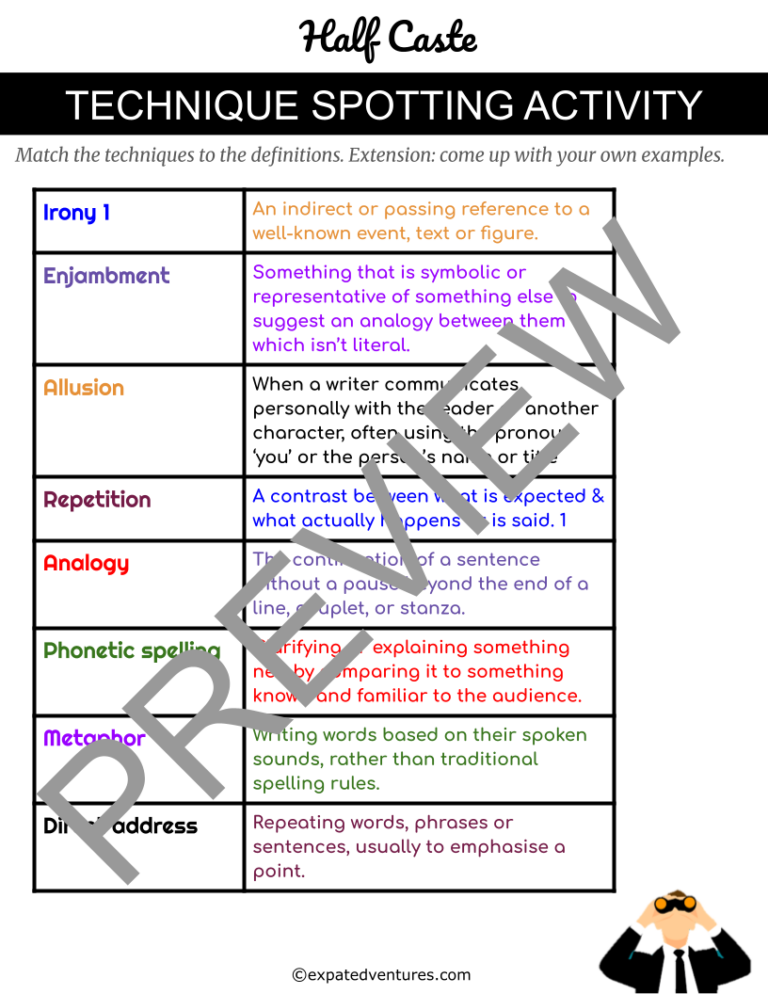
Before diving into the text, I quickly review key language techniques in the poem so that they are fresh in students’ minds as they read. This resource contains a matching activity. Students match the definition to the technique, which they can either copy, cut and paste or simply number. As an extension, students can write their own examples of the techniques. Moreover, this is a useful revision tool for and any GCSE poetry exam, including the unseen poetry for Edexcel IGCSE English Literature. When students know the language techniques implicitly, they naturally refer to them in their analysis and their marks improve.
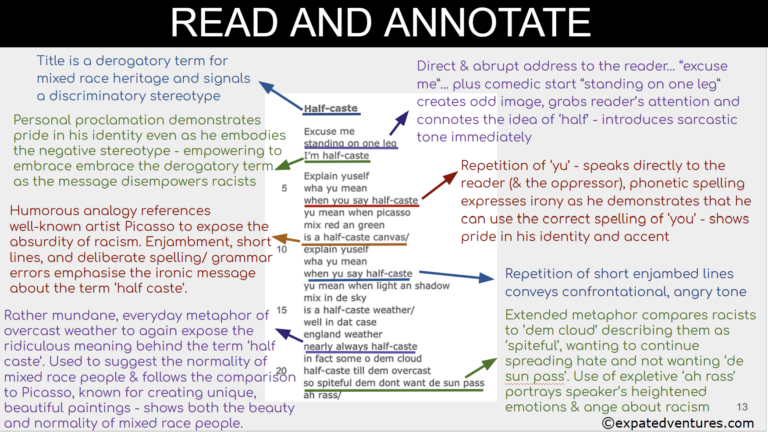
Half Caste line-by-line analysis
Before close textual analysis, I often ask students to do an initial reading for the tone and literal reading. It is a fairly straightforward poem for students to understand on a surface level – the narrator demands that the reader listens to his angry words. The challenge comes in unpacking how Agard explores the themes of racism and oppression, the meaning of those concepts and how they relate to identity and self-worth. Close textual annotations are a way to support students to unpack the deeper meanings.
When it comes to closely analysing the lines of the poem, there are a few ways of approaching the activity. You can read and annotate together with students completing the annotations in real time. Alternatively, you can split students into groups and ask each group to focus on a certain number of lines before feeding back to the class. Or you could read and discuss, then ask students to complete the annotations for homework.
There are many ways of approaching close textual analysis; I find that varying the method for different texts keeps students interested through the unit. For poems specifically, I tend to do annotations as a class activity as poetry can be more abstract and harder for students to grasp than prose texts. This ‘Half Caste’ IGCSE resources pack contains detailed line-by-line annotations of the whole poem.
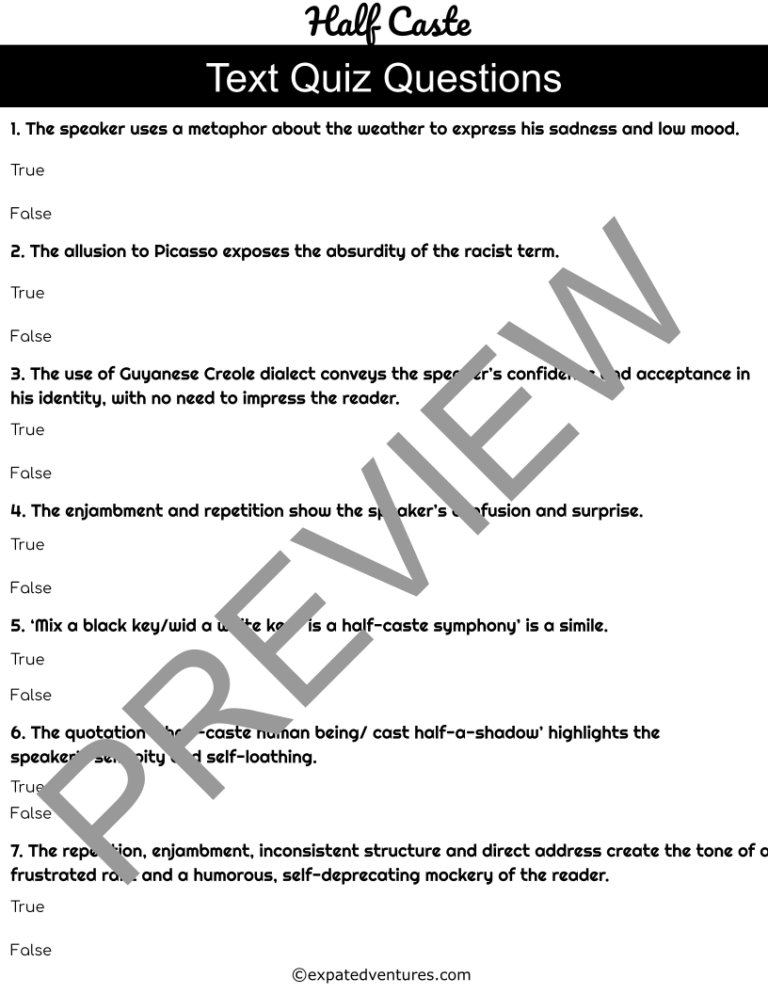
Edexcel Poetry Quiz with Answer Key
After analysing the poem, I do a quick assessment for learning AFL quiz with students to assess their understanding of the language and structure of the poem. Then, I introduce exam practice questions. Editable quiz questions for a straightforward low stakes multiple choice quiz with answers are available on the slides and in PDF form with these Half Caste IGCSE resources. Depending on your time and the nature of your class, you can do this as a whole class activity on the interactive whiteboard or hand out to students to do in pairs or individually.
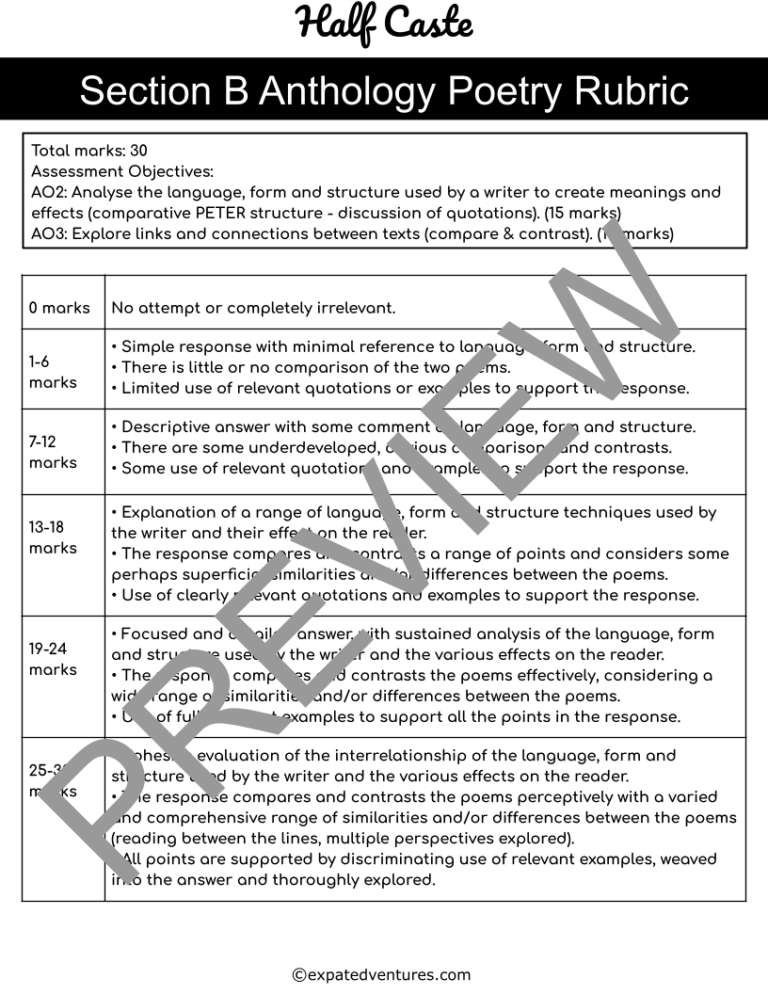
Half Caste Rubric & Comparative Paragraph Structure
The Section B poetry anthology question on the IGCSE English Literature Paper 1 exam is a 30-mark question on two of the 16 anthology poems. You can find them in Part 3 of the anthology. Although it is one question based on poems they have studied, students need to ensure they are making perceptive comparisons as well as exploring and analysing the poems. Therefore, I reinforce to students that they must know all 16 of the poems and comparisons between them very well to write a detailed essay on just two of them in the exam.
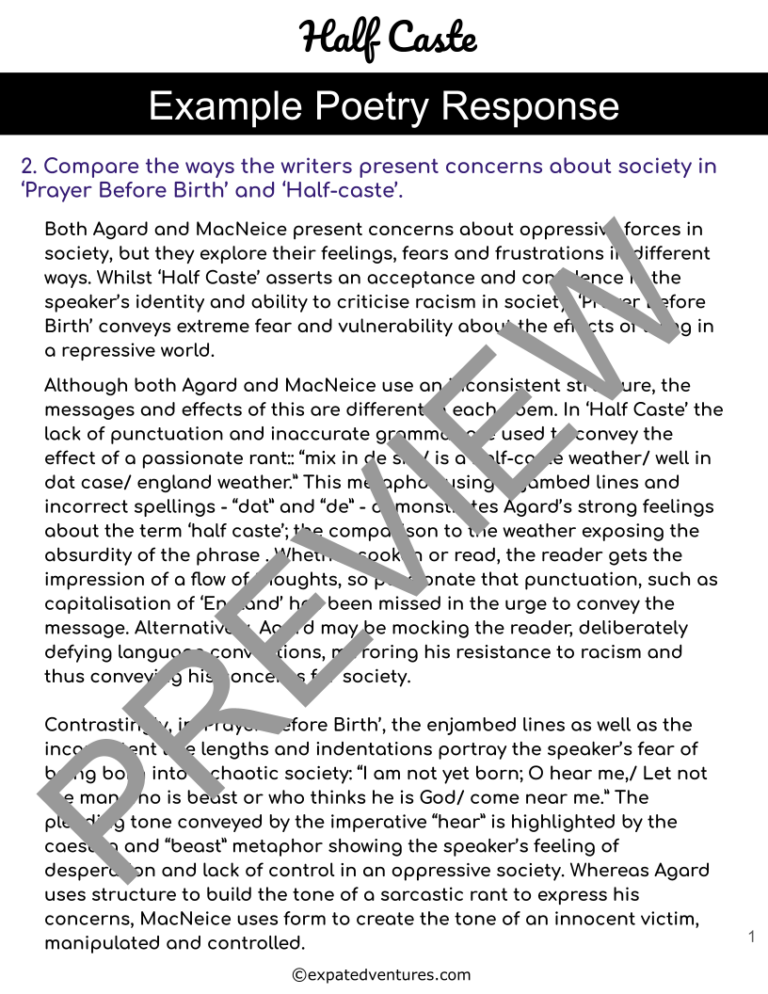
There are some steps to take before asking students to write a response. Firstly, it may be useful to take students through the rubric so that they familiarise themselves with how the response is awarded. Then, you can take students through the example comparative paragraph, which is essentially an extended version of the PETER paragraph (point, evidence, technique, explain, refer). This way, there are scaffolds in place to support students to produce high quality responses, and you can demonstrate how the paragraph hits the mark scheme pointers, such as exploring techniques and making perceptive and detailed comparisons. It also directly links to the question, which is something examiners look for.
In this Half Caste GCSE poetry unit, there is a rubric and an example comparative paragraph so that students can see how to write a cohesive analytical paragraph. This is a useful way to ease hesitant students into writing a full comparison of the poems. Also, using the comparative paragraph structure prevents students from writing about one poem, then another. Thus, missing out on the comparative back and forth which usually warrants more marks in the exam.
English Literature Poetry Comparison Grid
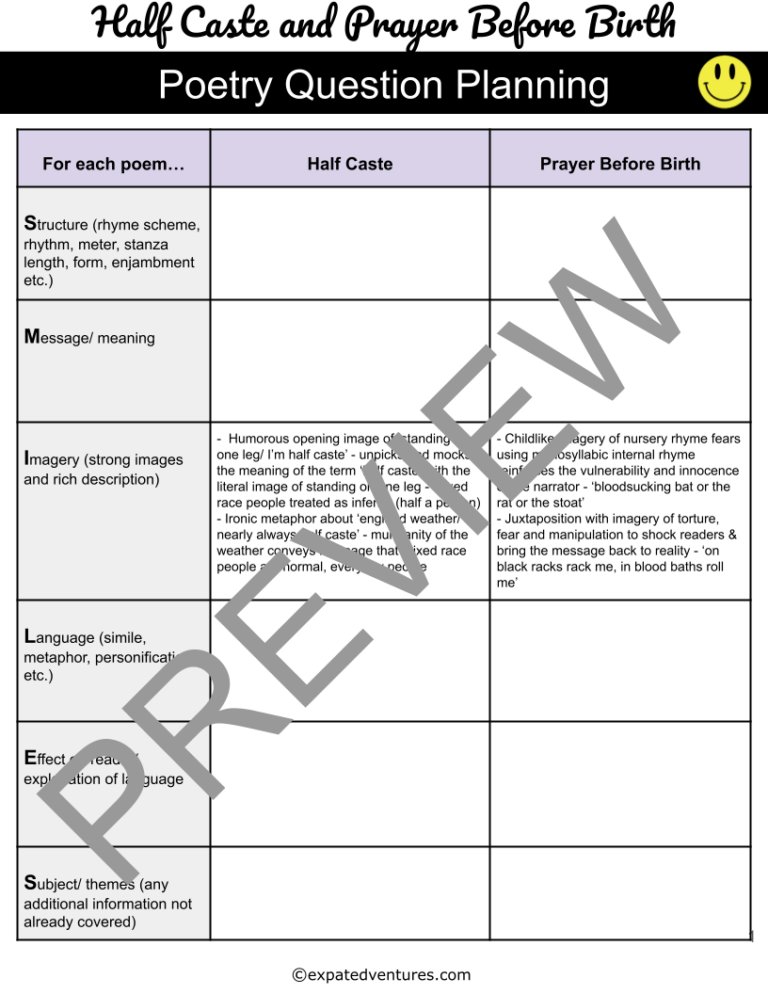
Students often struggle to plan their ideas; they are left wondering; how do I start? What do I write and in what order? How can I compare these poems? A comparison grid is a good tool for students to revise the texts but also produce a cohesive analysis and plan out their ideas so that they avoid repetition.
I have included an example of a planning grid in these Half Caste IGCSE resources, useful for analysis and making links between the poems. Additionally, I organised the comparison grid into the ‘SMILES’ acronym (structure, meaning, imagery, language, effect, subject) to help them explore different aspects of the poems. Students can then make notes on these sections for each poem so that the comparisons and contrasts become clear. Also, the acronym will be quick and easy for them to remember under exam conditions.
Edexcel Half Caste IGCSE Exemplar Analytical Essay
Included in these ‘Half Caste‘ IGCSE resources, I have provided an editable full-mark example answer for Section B, worth 30 marks. I find it the most effective to ask students to have a go at answering first, do some peer or teacher marking of their answers, then present them with the full-mark response. Often, I find if students achieve a mark they are unhappy with, they ask ‘what do I have to do to increase my mark?’ Or, they might say ‘how do I make it better?’ These are great questions as it shows engagement with the improvement process. This is when providing them with an exemplar comparative essay can help them ‘see’ exactly how to plug the gaps in their own response.
There are examiner’s comments in the notes section of the presentation about this response. Essentially, to be awarded full marks, there should be evidence of perceptive analysis. I explain to students that the answer goes beyond ‘obvious’ points and draws out the writer’s range of feelings and connection to the reader’s reaction. Consider whether the writer changes their perspective and how language and structure interconnect for effect. For example, a long syndetic list can also contain strong, emotive verbs. Quotations must be relevant to the points made for a student to fall in the top band of the mark scheme, and multiple quotations should be used through the response.
GCSE Imaginative and Transactional Writing Practice
There are also a couple of writing prompts included in these Half Caste IGCSE resources. Time-permitting, this is an excellent text to base a creative or transactional writing piece around as it is so steeped in vivid imagery. You could have the students write an article, story or letter based on the text. This can help develop skills required for Section B of English Language Paper 1 (Transactional Writing) and Section B of English Language Paper 2 (Imaginative Writing), whilst increasing their engagement with the poem Half Caste.
Edexcel GCSE Poetry Revision
To sum up, here are some of the most effective techniques for teaching the 16 anthology poems:
Hook students with an intriguing starter activity
Use alternative methods to closely analyse and annotate the text
Quiz students for quick AFL strategy to assess whether they are engaging with the text
Practise past paper questions, including comparisons between the poems
Study model answers, including examples of typical mistakes students make in the exam responses
Offer an optional creative activity as homework or an extension to challenge students’ perceptions of the poem
Good luck teaching Half Caste. As many students relate to the humorous irony, phonetic spelling and unusual structure, this poem often encourages them to question the effects of offensive labels and making assumptions based on race. Comment below if you can add any useful teaching and learning techniques for this text.
If you enjoyed this article about teaching ‘Half Caste’, you might also find value in my Edexcel IGCSE English Language Paper 2 guides and resources for ‘Out, out-‘ and The Bright Lights of Sarajevo. In addition, there are also Edexcel IGCSE English Language Paper 1 guides and schemes of work for many of the set texts, including Passage to Africa and Young and Dyslexic. Follow my store for more as resources are constantly being added.